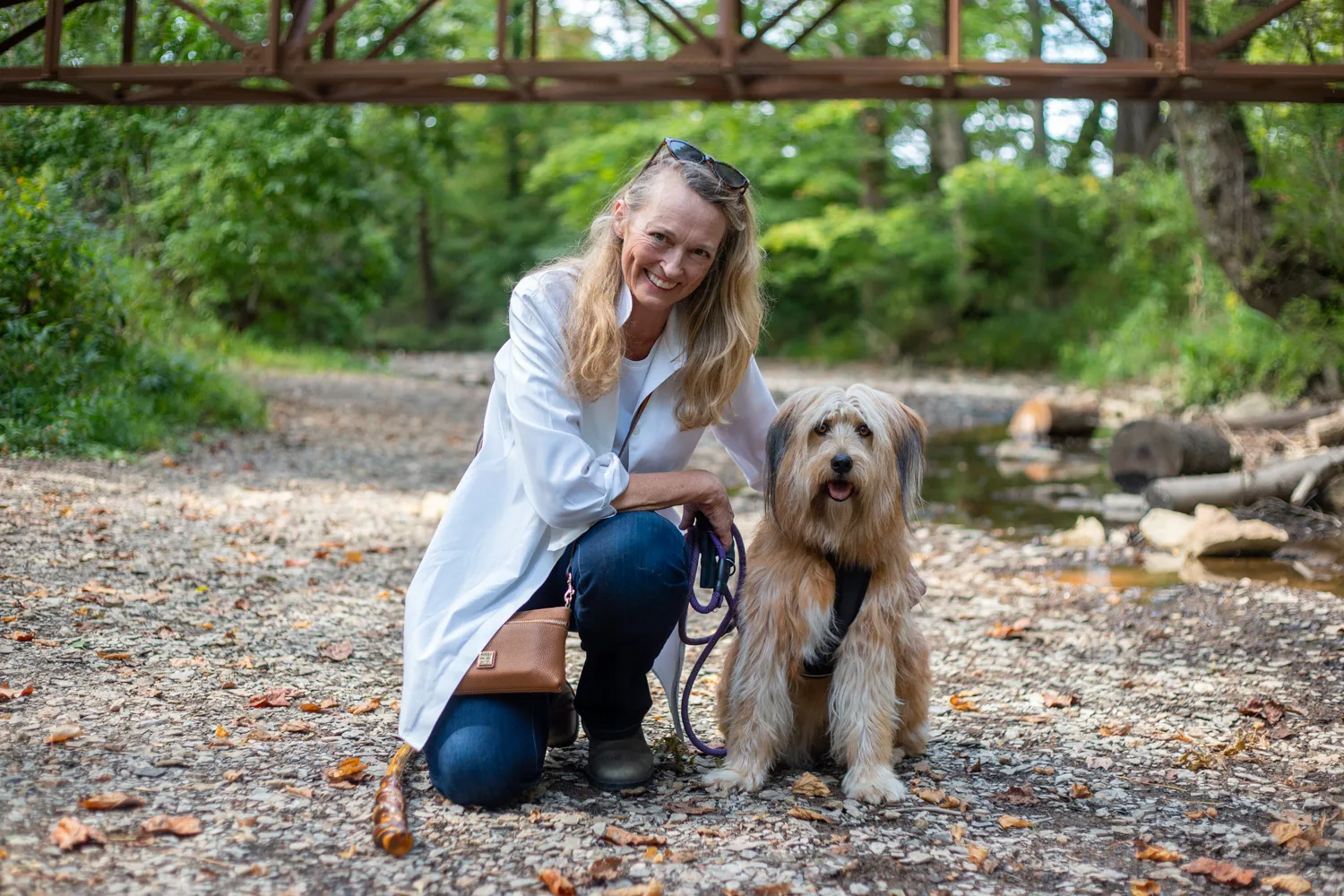
A Reporter Comes Home
When journalist Whitney McKnight moved back to Kentucky in 2023, she expected to find the familiar rhythms of local news: small-town stories, civic updates, maybe a few old-school columnists keeping watch. Instead, she often found silence.
As a former federal health policy reporter in Washington, D.C., Whitney had spent years writing about complex systems and accountability. As she watched promising economic growth taking shape in and around Berea, she sought more detailed coverage of what those changes meant for residents.
Her outlet—The Edge, short for Reporting from the Edge of Appalachia—was born partly out of her need to fill the gap she saw in local reporting. At the time, she had no idea that the decision would eventually connect her, through Grant Ready Kentucky, to a broader network of people, tools, and support designed to help Kentuckians bring their local visions to life.
Starting from Scratch
At first, Whitney thought she would only cover land use. But she soon realized that to tell the full story, she’d have to show up everywhere. “I realized you have to cover City Hall to really know what is going on,” she says. “So I started doing that.”
From city council meetings to fiscal court sessions in Richmond, her coverage quickly widened. “Suddenly, we had thousands of readers. ‘Oh, I guess I’m really doing this,’” she remembers thinking.
And that reach has only grown. Some months, The Edge has 22,000 readers—more than Berea’s entire population. “I’m obviously filling a need,” Whitney says.
What Changes When Someone Is Watching
It didn’t take long for Whitney’s reporting to make an impact. In one case, after The Edge reported on a severely neglected house that had become a health concern for neighbors, the city took action to close and secure the property.
The tone of local meetings also began to change after The Edge started covering them. “Every meeting now, somebody from the council bench or the mayor will look at me and say, ‘Remember, we have a press corps,’ which is me,” she says, laughing. “They make a point to let each other know they’re on the record.” Even at the county level, she’s noticed a shift. “Two weeks ago, I was at a county meeting, and the judge executive said, ‘Thank you, media, for being here. Appreciate your interest.’”
Residents have also started turning to her when they want to be heard. “I just reported on a major bourbon distillery that wants to set up shop here in the county,” she says. Community members reached out to The Edge to make sure their concerns and hopes were reflected in the public conversation. “They were relying on me to tell their story.”
“I can’t measure it yet,” Whitney says, “but I really do think what’s happening is that people are feeling heard. They know that their voice will be counted because I will make sure to include it. And I’m very proud of the fact that local government officials tell me that I’m fair,” even though, she emphasizes, she never gives them a “pass.”
The Power of Connection
For all her skill and determination, Whitney knew she would need help to make her work sustainable. Before publishing her first issue, she went looking for that support. “I went to Grant Ready Kentucky back in September of last year,” she says, “and I told them, I need to know how to find some money because I think I’m going to start a paper.”
At a grant writing workshop hosted by Grant Ready Kentucky, Whitney met two people who would become anchors in her journey. Hannah Conover, Grant Ready Kentucky’s Executive Director, “is amazing and she’s so enthusiastic and helpful,” Whitney says. At that same workshop, she was trained and coached in grant writing and proposal development by Melissa Vermillion, GRKY’s Chief Strategy Officer.
Melissa’s no-nonsense approach to grant writing resonated with Whitney. “I paid close attention because I could tell she knew what was important and what was essential,” Whitney says.
Hannah’s approach was different but equally powerful. “She was one of the first people I met,” Whitney says.“So kind and warm and encouraging. And she followed up, which was also unusual and nice.”
Through Grant Ready Kentucky’s network, Whitney met Richard Young of Civic Lex, a Lexington nonprofit working to increase civic health and participation in local decision-making. “If I hadn’t met him,” Whitney says, “I wouldn’t have known what options I could choose from that have proven to be instrumental.” That meeting led her to the Tiny News Collective, which now provides fiscal sponsorship, technical support, and national connections. “Had I not met Richard, I don’t think I would have gotten my act together as quickly. He pointed me in the right direction.”
For Whitney, that path from Grant Ready Kentucky to Civic Lex to Tiny News Collective shows how the right connections at the right time can move a local idea toward durable impact. “That led to me making other connections in Appalachia, which will ultimately be important because I'm applying for grants that will cover land use further into the mountains.”
The Payoff
The Edge quickly built an audience and a voice, but what it needed was a financial runway. Grant Ready Kentucky’s Grant Writing workshop gave Whitney the framework to leverage grant funding and other technical assistance resources.
“I have won a $20,000 grant by following Melissa’s instructions,” Whitney says. “I also got business support given to me by a local nonprofit.”
Those wins confirmed that she was on the right path and that the structure she’d learned through Grant Ready Kentucky had changed the trajectory of her work. “Grant Ready Kentucky focused me in the way I needed to be focused,” she says. “Even though I’m originally from Kentucky, I returned with zero knowledge about Kentucky social networks. Hannah’s connections really helped me learn the necessary basics.”
Building the Future of Local News
Today, Whitney’s challenge isn’t finding stories; it’s building a structure strong enough to spread them far and wide. “I really want to sustain this. I want this to be my full-time job.”
Her goals are clear: “I want to hire beat reporters. An education reporter. I want infrastructure that supports an advertising department, membership department, and ultimately, a print paper.” That print edition could be transformative. “I get asked all the time whether or not I’m in print,” she says. “I believe being in print would greatly increase my ad revenues and my subscriptions.”
In the meantime, she’s building community in other ways, including an “Ask Me Anything” potluck. “It’s a fundraiser, and it’s members only,” she says. “A councilwoman said to me, ‘You have a super-fan club. I’m in it. And we want to know how you do what you do.’”
As she looks ahead, with over 20,000 readers and growing local trust, Whitney remains grounded in the moment that made it all possible. “Melissa is the motivator,” she says. “And Hannah is the heart. That warmth that was shown to me has mattered. Even if I don’t ever have a reason to talk to her again, Hannah will always be somebody who I feel like was in my corner from the beginning.”