.webp)
A Judge’s Second Life: When a Diagnosis Became a Mission
Jane Rice Williams began practicing law in Kentucky in 1995, eventually serving as an Administrative Law Judge with the Department of Workers’ Claims. Over the course of her career, she was inducted into both the College of Workers’ Compensation Lawyers and the National Association of Workers’ Compensation Judiciary Hall of Fame.
By any measure, by the mid-2010s, Jane had had an illustrious career, earning her the right to a restful retirement. But life had other plans.
In 2016, Jane was diagnosed with Parkinson’s disease, a progressive neurological condition that affects movement, cognition, energy, and nearly every aspect of daily life. As she explored treatment programs in her hometown of London, Kentucky, she discovered a lack of local options to help people like her stay active, informed, and connected.
To address that gap, in 2018, she founded Parkinson’s in Motion, a nonprofit with a mission to, as Jane put it, “educate, provide services, and meet the needs of those with Parkinson's,” particularly in the underserved and isolated areas of Eastern Kentucky, where Jane has a large network thanks to her time served as a workers compensation judge.
Over time, word spread of her diagnosis, and folks began reaching out. “Anytime anybody gets diagnosed with Parkinson's, they call me up,” she said. While Jane had the network to connect with folks living with the condition, she, like many people who start nonprofits, was less connected to sources of funding.
Searching for Answers and Finding a Partner
Initially, Jane did the best she could with limited resources. When it became clear that the organization needed additional support, however, she realized she needed to secure grant funding. The problem was, as she put it, that “We didn't know how to write grants. We didn't know how to find grants.” Her only knowledge of available grants was federal or national opportunities, which she thought were far out of reach for a new, rural nonprofit.
Then, while searching online for support, she discovered the nonprofit Grant Ready Kentucky,
Jane was surprised by how easy it was to connect with Grant Ready Kentucky and begin getting support. “When I first called, I couldn't believe it: they didn't want anything from me except to know what I needed.”
Grant Ready Kentucky staff walked Jane through the basics of grant seeking, from search strategy to narrative structure and everything in between. To Jane’s surprise, that support was provided at no cost.
And the support mattered, especially to an organization based in underserved Appalachia. It was a remarkable change from how Jane had felt treated by, for instance, many funders, who “just said no and wouldn’t explain why. We're used to people telling us no because they don't think we're worth it.”
A Stronger Grant, a State Match, and New Momentum
As Parkinson’s in Motion began its earnest search for funding that matched its scale and mission, Grant Ready Kentucky became a crucial guide. Jane regularly connected with the team about potential opportunities. “Our organization can call any day and say, ‘We've seen this grant. What do you think about it?’ And they'll either say, ‘That's a good one for you,’ or ‘That's not the best fit for your organization.’”
Eventually, that support led Parkinson’s in Motion to an Appalachian Regional Commission equipment grant. That federal grant opportunity allowed them to leverage Kentucky’s match pool, the GRANT Program. Created in 2023 and expanded in 2024, the GRANT Program is a $200 million match pool that helps communities and nonprofits meet required local match, often the biggest barrier to pursuing federal funding. After seeing match requirements stall too many strong projects, Grant Ready Kentucky helped shape the match pool approach and advanced its creation in Frankfort.
Applying for a federal grant can be a complicated process for any organization, let alone a small, rural nonprofit. Undaunted, Jane drafted the proposal and then turned to Grant Ready Kentucky for guidance. “They reviewed what we had written and made sure we had everything in line, and that was very helpful,” she said.
Jane noted how grant consultant Ruthie Caldwell and Executive Director Hannah Conover became trusted collaborators in the process. “Ruthie and Hannah are both very good at helping us put together a narrative and helping us review our work.”
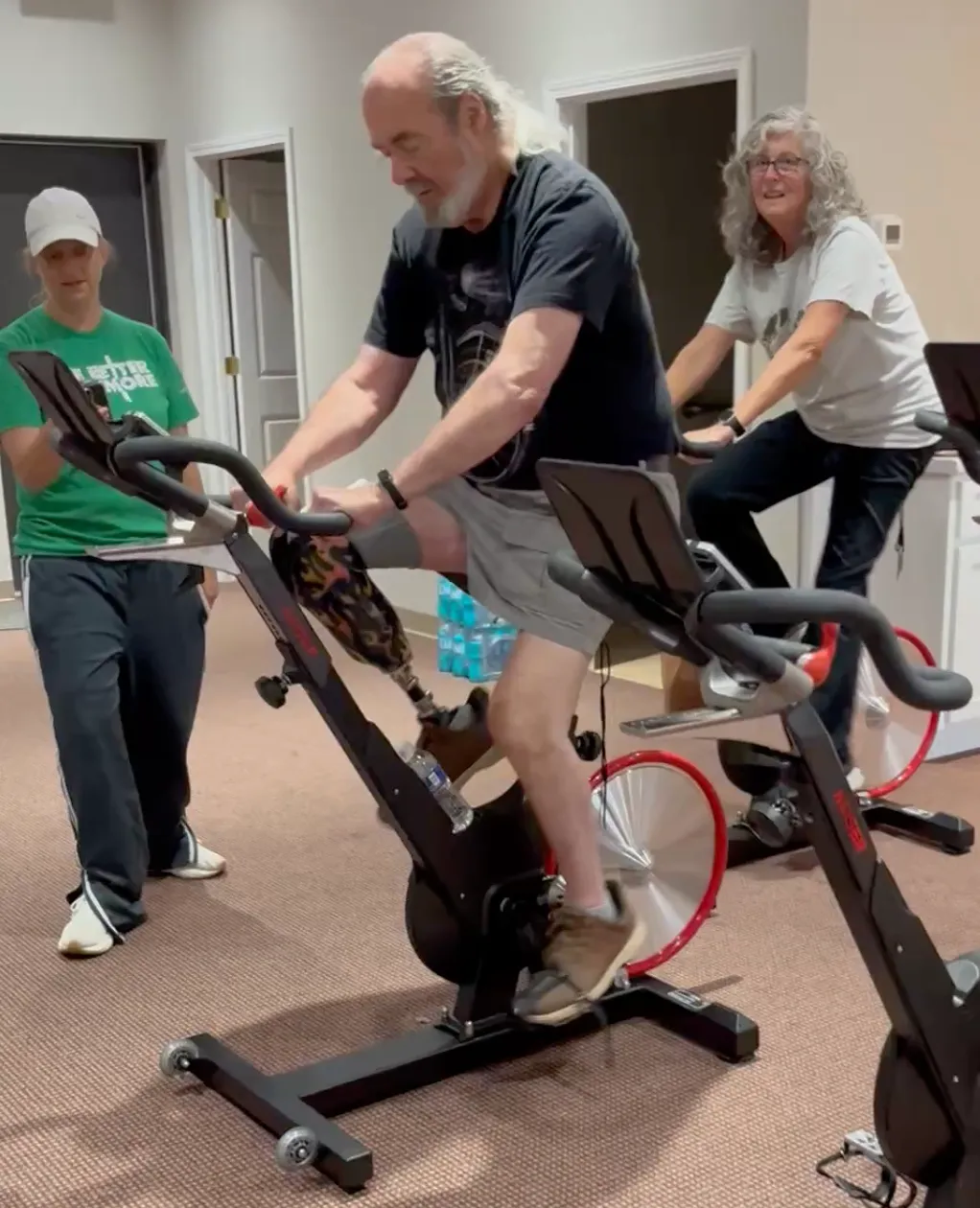
The grant was approved. The state awarded the matching funds. A long-imagined program took shape. With the funds, Parkinson’s in Motion purchased five Keiser stationary bicycles, designed for high-intensity exercise that has been proven to support neuroplasticity in people with Parkinson’s.
Today, those bikes anchor a growing movement program. “We have people who come by a couple of days a week and ride together, and we have a coach who works with them through a 30-minute program.”
So far, the class has gotten rave reviews from participants. “They love it,” Jane said, “They really love it. They say they feel so good when they get off the bikes.” And word is getting around about the program and its benefits; it recently became part of a research study through a partnership with the University of Kentucky.
A Future Built on Movement And Possibility
Jane’s aspirations for Parkinson’s in Motion are both practical and ambitious: “To pay the rent. That's important,” but also to explore a partnership with Rock Steady Boxing (a well known Parkinson’s exercise program with an international presence), statewide environmental work around Parkinson’s-related chemicals, and ongoing leadership on Kentucky’s new Parkinson’s Disease Registry, which was born out of legislation she helped move forward.
Jane recommends Grant Ready Kentucky to nearly every nonprofit leader she meets. As she put it, “I think Grant Ready Kentucky is great at helping you know what's feasible for your organization based on its size.” What she appreciates most about GRKY is “how nice and how genuinely interested they are in helping us. They've given really, really good feedback, and they have made getting that feedback effortless for us.”
Jane said that although Parkinson’s may have changed her life, it didn’t diminish it. “In the beginning, all I wanted was to be able to walk out my door and get the exercise I needed without having to drive three towns over. Now, we’ve just about got that.” And, in seeking support for herself, she has created a much-needed resource for the Parkinson’s community in Kentucky. All supported by Grant Ready Kentucky and the GRANT Program, ensuring Jane’s story and stories like hers don’t end with another “no.”